Thursday, March 16, 2023

The Vision and Values of Jesus #1

Christuskopf - Gemäldegalerie Berlin - 5250510.jpg


"He Gets Us!"  But do we get him?

About a year ago a different kind of "faith-based" TV commercial caught my attention. While black and white snapshots of young inner-city "troublemakers" flashed across the screen, the voice-over began, "Jesus knew how it felt like to be falsely judged. The government and religious authorities of Jesus' day saw Jesus and his disciples as troublemakers, lawbreakers, and rebels." The commercial ends with this appeal, "The truth is, they were rebels. They were challenging authority. But they were not criminals.  They were rebels for peace. They challenged others to love everyone.  This was a radical idea that the leaders of that time couldn't see or wouldn't embrace.  But that didn't stop Jesus or his followers. They did the right thing despite the misunderstanding and biases within their society." If you haven't seen it, here is the 30 second commercial:


Since viewing that commercial, I've seen many with the "He Gets Us" label and I've agreed with much of what the commercials have to say.  Yet when I heard that this campaign was planing to spend $20 million on 2 Super Bowl commercials I thought it was time to learn more about the people  behind the He Gets Us campaign.  The group calls itself The Servant Christian Foundation, a non-profit primarily comprising anonymous donors.  I also learned that of the more than 50 ads aired during the Super Bowl the He Gets Us ads were rated 5th best and 15th best.  The first was a 30 second ad and the other was 60 seconds.  Both ads cost The Servant Christian Foundation $21,000,000 and the foundation plans to spend $2 billion on similar ads and posts over the next 3 years.

I believe the folks behind this media campaign are sincere in their attempts to communicate  an honest and fresh view of Jesus via TV, radio, digital ads, billboards and other platforms.  Yet, when thinking about the way Jesus chose to share his message, other than the feeding of the 5000 and the sermon on the mount, Jesus more often chose smaller, more intimate settings to build lasting, loving, life changing relationships with people.  And that has been my experience as well. Over the years, I've been involved in a number of those big, flashy "Hawaiian  Luau" kinds of events that have taken enormous amounts of time, energy and resources to put together and pull off. Those kinds of events are usually a lot of fun, but they seldom build lasting, loving, life changing relationships.

So, as persons of faith who are trying to live out the values of Jesus and share his values with others, how can we be more effective in the use of our time, energy and resources?  That's the issue I'll try to address in a series of blog posts entitled: The Vision and Values of Jesus.

The next post will focus on the attention Jesus gave to creating a new kind of community that would live out and share his values.  This post asks the question: Is "community" as we know it, "community" as Jesus intended it?


Wednesday, March 15, 2023

The Vision and Values of Jesus #2


Jesus Came to Create a New Kind of Community

Jesus challenged his followers to launch a movement that would change the world. He chose to do this by creating a new kind of community. This new community was eventually called "Church." Unfortunately few churches today reflect the kind of community Jesus had intended.

To create that first new community Jesus hand-picked a rag-tag group of ordinary every day characters that included fishermen and tax collectors. And then he added a variety of misfits and other sinners who would become the new community. The Book of Acts offers this description of what life looked like within the community that gathered in Jerusalem:
They devoted themselves to the apostles’ teaching and to fellowship, to the breaking of bread and to prayer. Everyone was filled with awe at the many wonders and signs performed by the apostles. All the believers were together and had everything in common. They sold property and possessions to give to anyone who had need. Every day they continued to meet together in the temple courts. They broke bread in their homes and ate together with glad and sincere hearts, praising God and enjoying the favor of all the people. And the Lord added to their number daily those who were being saved. — Acts 2:42-47
What a simple plan: learning TOGETHER, meeting TOGETHER, eating TOGETHER, praying TOGETHER, believing TOGETHER, sharing TOGETHER, laughing TOGETHER, worshipping TOGETHER, reaching out to care for our neighbors TOGETHER.  This is the kind of "Community" Jesus intended.

There are places in the world where faith communities are experiencing "Community" as Jesus intended it. But in much of Europe and North American our faith communities have yielded to the values of the world and abandoned the values of Jesus. Fewer and fewer Europeans choose to participate in a faith community. And in America we are slowly catching up to this trend. Some find hope in the growing “Mega Church” movement all around the world. One of the most helpful trends that has emerged within this movement has been the introduction of "small groups" within the larger church.  This has helped to gather smaller, more intimate faith communities within the much larger church body. Sadly, the number of those who are willing to take the time to participate in a small group is usually much smaller than those who participate in the larger worship gatherings where it is very difficult to create "Community" as Jesus intended it.

How can we build communities of faith that reflect the values that Jesus cherished, taught and lived by. The very values that began to turn the world right-side-up. The heart and soul values that turned ruined sinners into redeemed saints. The values that enabled ordinary people to gather as creative, caring communities; "Community" as Jesus intended it. What might help to reshape how we think about and work toward creating the kind of community Jesus challenged his first followers to create? Here are a few suggestions:

- If we believe "Jesus is Lord," that means following his vision and values 
- Christian community is formed by gathering around his vision and values
- The Bible needs to be viewed through the lens of his vision and values
- Community focuses more on building relationships, than bigger buildings
- Community is fortified by loving and learning from Jesus and each other
- Communities of faith are willing to take the light of Jesus into dark places
- Community as Jesus intended will continue to turn the world right-side-up

Tuesday, March 14, 2023

The Visions and Values of Jesus #3


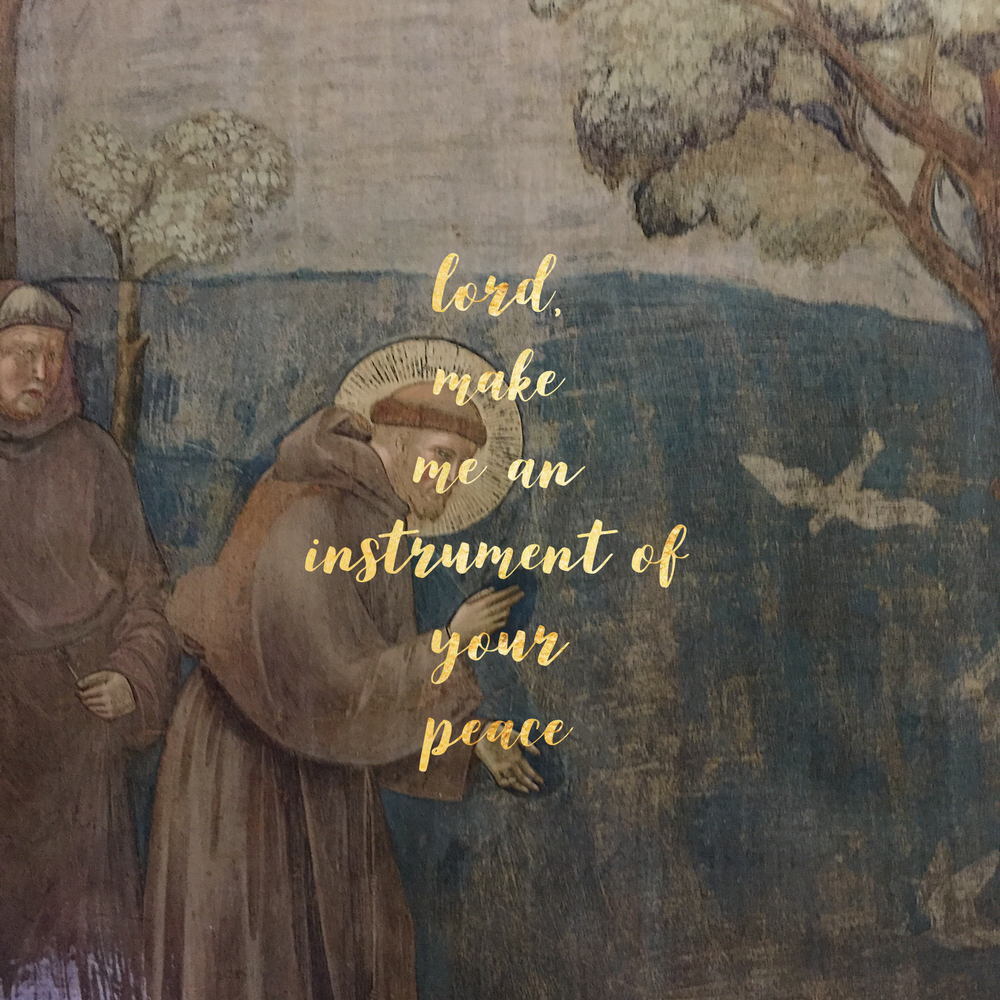
Lord, Make Me an Instrument of Your Peace — Chris Cox

Instruments of Peace

On May 4, 1979 Margaret Thatcher stood on the steps of 10 Downing Street in London and began her term as Prime Minister of the United Kingdom.  She surprised those who had gathered that morning, and fixed herself in the national consciousness with a prayer that begins, "Lord, make me an instrument of your peace." Here is the full text of the prayer:

Lord, make me an instrument of your peace:
where there is hatred, let me sow love;
where there is injury, pardon;
where there is doubt, faith;
where there is despair, hope;
where there is darkness, light;
where there is sadness, joy.
O divine Master, grant that I may not so much seek
to be consoled as to console,
to be understood as to understand,
to be loved as to love.
For it is in giving that we receive,
it is in pardoning that we are pardoned,
and it is in dying that we are born to eternal life.

For many years the prayer has been attributed to St Francis of Assisi (1181-1226), an Italian itinerate preacher who founded the religious order known as the Franciscans. However, Francis had been dead almost 700 years before it was first printed, anonymously, by the French clerical magazine, La Clochette, in 1912. When the terrors of World War 1 began to unfold a few years later, the prayer became very popular, but wasn't linked with St Francis until a postcard with a picture of the saint on the reverse side was widely circulated in 1920. From that time forward it became known as "The Prayer of St Francis."

We will probably never know the name of the prayer's real author, but that doesn't diminish its influence. Several years I began to regularly include the prayer in my morning prayers.  I like how it includes many of the teachings of Jesus found in the gospels. These teachings will be the focus this blog over there next several weeks.

The first of these values emphasizes peacemaking. 700 years before Jesus gathered his disciples "up on the mountain," and said to them "Blessed are the peacemakers for they shall be called sons of God," the Prophet Isaiah announced the Messiah would be know as the Prince of Peace:

"For to us a child is born, to us a son is given; and the government shall be upon his should, and his name shall be called Wonderful Counselor, Mighty God, Everlasting Father, Prince of Peace. Of the increase of his government and of peace there will be no end, on the throne of David and over his kingdom, to establish it and to uphold it with justice and with righteousness from this time forth and forevermore.  The zeal of the Lord of hosts will do this" (Isaiah 9:6-7). 

Isaiah claimed the Prince of Peace would reign on the throne of David.  This is intriguing because David was not known to be a peacemaker. David was a warrior, Jesus chose the path of peace. David's reign was charactered by waging war and the shedding of blood. Jesus' reign was defined by his willingness to shed his own blood so that, "Of the increase of his government and of peace there will be no end." 

Here's another interesting point: God made it clear David would not be permitted to build the temple because: "You have shed much blood and have waged great wars. You shall not build a house to my name, because you have shed so much blood before me on earth" (1 Chronicles 22:8). Jesus, on the other hand, was anointed to build the Kingdom of God on earth.  Because of that, he received "the name which is above every name" (Philippians 2:9).

What does this mean for those who want to live by the vision and values of Jesus?  The "Sermon on the Mount" (Matthew 5-7), represents a kind of "Christian Constitution" for the citizens of the government that rests upon the shoulders of Jesus. Regrettably, some of the citizens of this "government" have chosen to amend the constitution, picking and choosing what to follow and what to ignore. Clearly, many of the teachings found in the Sermon on the Mount challenge our natural human impulses, and require a lot of prayer and grace to make them part of our lifestyle. Some require more prayer and grace than others:

  • “Blessed are the meek..." Matt 5:5
  • "Blessed are the peacemakers..." Matt 5:9
  • “Blessed are those who are persecuted..." Matt 5:10
  • "Blessed are you when men revile you..." Matt 5:11
  • "Love your enemies..." Matthew 5:44
  • "Do not lay up for yourself treasures on earth..." Matt 6:19 
  • "Do not be anxious about your life..." Matt 6:25
  • "Seek first the kingdom of God..." Matt 6:33
  • "Judge not, that you may not be judged... Matt 7:1
  • "Take the log out of your own eye..." Matt 7:5 

As these become woven into our lives, we needn't feel smug and become complacent. But because the bar has been set so low, those who are faithful in following the teachings of Jesus are thought to be exceptional Christians. No, this needs to be thought of as normal behavior for those who are followers of Jesus. 

The "Prince of peace," calls us to "seek first the kingdom of God" (Matthew 6:33), rather than following the values of the world. He invites us to pray: "Your kingdom come and your will be done on earth as it is in heaven" (Matthew 5:10). The Prince of Peace invites us to become "Instruments of Peace," committed to playing God's song.