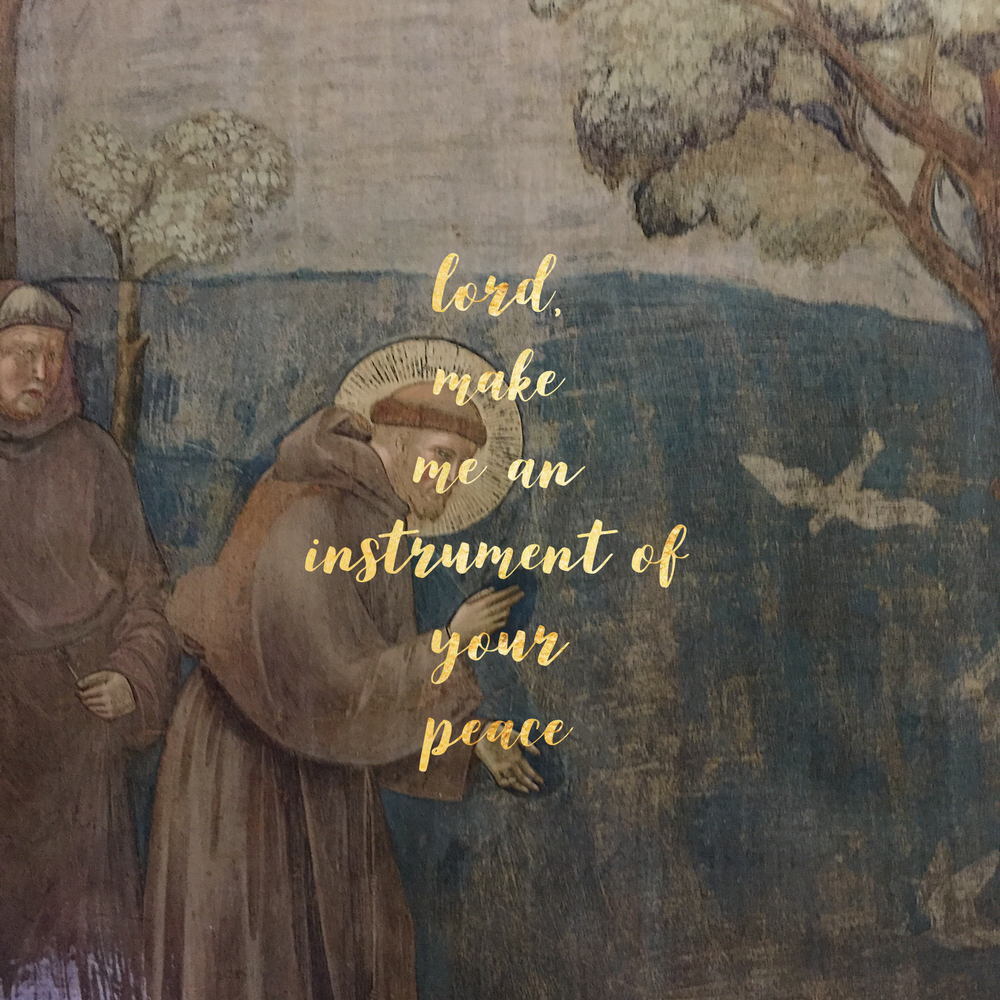
Instruments of Peace
On May 4, 1979 Margaret Thatcher stood on the steps of 10 Downing Street in London and began her term as Prime Minister of the United Kingdom. She surprised those who had gathered that morning, and fixed herself in the national consciousness with a prayer that begins, "Lord, make me an instrument of your peace." Here is the full text of the prayer:
Lord, make me an instrument of your peace:
where there is hatred, let me sow love;
where there is injury, pardon;
where there is doubt, faith;
where there is despair, hope;
where there is darkness, light;
where there is sadness, joy.
O divine Master, grant that I may not so much seek
to be consoled as to console,
to be understood as to understand,
to be loved as to love.
For it is in giving that we receive,
it is in pardoning that we are pardoned,
and it is in dying that we are born to eternal life.
For many years the prayer has been attributed to St Francis of Assisi (1181-1226), an Italian itinerate preacher who founded the religious order known as the Franciscans. However, Francis had been dead almost 700 years before it was first printed, anonymously, by the French clerical magazine, La Clochette, in 1912. When the terrors of World War 1 began to unfold a few years later, the prayer became very popular, but wasn't linked with St Francis until a postcard with a picture of the saint on the reverse side was widely circulated in 1920. From that time forward it became known as "The Prayer of St Francis."
We will probably never know the name of the prayer's real author, but that doesn't diminish its influence. Several years I began to regularly include the prayer in my morning prayers. I like how it includes many of the teachings of Jesus found in the gospels. These teachings will be the focus this blog over there next several weeks.
The first of these values emphasizes peacemaking. 700 years before Jesus gathered his disciples "up on the mountain," and said to them "Blessed are the peacemakers for they shall be called sons of God," the Prophet Isaiah announced the Messiah would be know as the Prince of Peace:
"For to us a child is born, to us a son is given; and the government shall be upon his should, and his name shall be called Wonderful Counselor, Mighty God, Everlasting Father, Prince of Peace. Of the increase of his government and of peace there will be no end, on the throne of David and over his kingdom, to establish it and to uphold it with justice and with righteousness from this time forth and forevermore. The zeal of the Lord of hosts will do this" (Isaiah 9:6-7).
Isaiah claimed the Prince of Peace would reign on the throne of David. This is intriguing because David was not known to be a peacemaker. David was a warrior, Jesus chose the path of peace. David's reign was charactered by waging war and the shedding of blood. Jesus' reign was defined by his willingness to shed his own blood so that, "Of the increase of his government and of peace there will be no end."
Here's another interesting point: God made it clear David would not be permitted to build the temple because: "You have shed much blood and have waged great wars. You shall not build a house to my name, because you have shed so much blood before me on earth" (1 Chronicles 22:8). Jesus, on the other hand, was anointed to build the Kingdom of God on earth. Because of that, he received "the name which is above every name" (Philippians 2:9).
What does this mean for those who want to live by the vision and values of Jesus? The "Sermon on the Mount" (Matthew 5-7), represents a kind of "Christian Constitution" for the citizens of the government that rests upon the shoulders of Jesus. Regrettably, some of the citizens of this "government" have chosen to amend the constitution, picking and choosing what to follow and what to ignore. Clearly, many of the teachings found in the Sermon on the Mount challenge our natural human impulses, and require a lot of prayer and grace to make them part of our lifestyle. Some require more prayer and grace than others:
- “Blessed are the meek..." Matt 5:5
- "Blessed are the peacemakers..." Matt 5:9
- “Blessed are those who are persecuted..." Matt 5:10
- "Blessed are you when men revile you..." Matt 5:11
- "Love your enemies..." Matthew 5:44
- "Do not lay up for yourself treasures on earth..." Matt 6:19
- "Do not be anxious about your life..." Matt 6:25
- "Seek first the kingdom of God..." Matt 6:33
- "Judge not, that you may not be judged... Matt 7:1
- "Take the log out of your own eye..." Matt 7:5
As these become woven into our lives, we needn't feel smug and become complacent. But because the bar has been set so low, those who are faithful in following the teachings of Jesus are thought to be exceptional Christians. No, this needs to be thought of as normal behavior for those who are followers of Jesus.
The "Prince of peace," calls us to "seek first the kingdom of God" (Matthew 6:33), rather than following the values of the world. He invites us to pray: "Your kingdom come and your will be done on earth as it is in heaven" (Matthew 5:10). The Prince of Peace invites us to become "Instruments of Peace," committed to playing God's song.

No comments:
Post a Comment